
RFID tags have a range of current uses, including inventory management, package tracking, toll collection, passport identification and airport luggage security.
Information is stored and processed on an integrated circuit on each tag, and is transmitted wirelessly via an antenna that responds to radio waves transmitted from an RFID reader.
Currently, if several RFID tags are in the vicinity of a reader, the reader usually evaluates one tag at a time, from tags with the strongest to weakest signal strength.
The newly developed system speeds up the evaluation process using a transmitter, receiver and emulator. By simulating the activity of an integrated circuit on the emulator, and transmitting a spread spectrum signal to the receiver, the system is able to simultaneously measure signals from multiple tags.
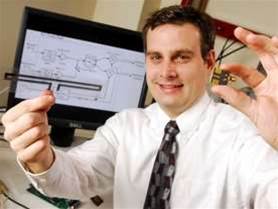
According to Gregory Durgin, who developed the technology at the Georgia Institute of Technology, the testbed eliminates the need to design and fabricate new chips for each phase of testing, resulting in savings of up to US$100,000 per chip.
“Not only could a testbed like ours save companies a lot of time and money, but it will also allow them [chip makers] to wring every last drop of range and reliability out of an RFID link,” said Durgin, an assistant professor at the institute’s School of Electrical and Computer Engineering.
“Our back-of-the-envelope calculations indicate that, with better waveform and tag designs, we can achieve an order-of-magnitude increase in the range and reliability of current passive RFID systems,” he told iTnews.
“This would open up a huge new application space for identification as well as sensors, telemetry, passive data exchange, medical sensing.”
The research, which was funded by the National Science Foundation, has successfully evaluated up to 256 antennas operating at 915 megahertz in a 36 square metre field of view. Eventually, the testbed will be used to test antennas at frequencies as high as 5.7 gigahertz.
Currently, only one prototype has been built, which will be used in the school’s laboratory to develop the next generation of RFID technologies, in collaboration with RFID companies like Impinj, Alien, Intermec, and TI.
However, Durgin expressed an interest in building more testbeds with industry partners, which he expects to cost about US$250,000 each in labour and supplies.
“Right now we see the testbed as a tool for cooperating with the RFID industry in streamlining their design process. But we would enjoy helping industry to build their own testbeds,” he told iTnews.
“[The cost is] pretty reasonable considering the time and cost savings in a growing, multi-billion dollar industry,” he said.



.jpg&h=140&w=231&c=1&s=0)
.jpg&h=140&w=231&c=1&s=0)




 iTnews State of Security Breakfast
 iTnews State of Data & AI Breakfast
 Forrester's AI Forum Sydney
 The 2026 iAwards
.jpg&w=120&c=1&s=0) Integrate 2026
Integrate 2026








_(1).jpg&h=140&w=231&c=1&s=0)